
Introduction
The world of cancer treatment is on the brink of a major shift. For years, we’ve relied on broad treatments that can be tough on the body. Now, imagine a therapy that teaches your own immune system to fight cancer cells specifically. That’s the promise of a new cancer vaccine from Russia. It represents a move toward more personalized and intelligent ways to combat cancer, offering hope for a future where treatment is both effective and gentle.
Overview of Russia’s Cancer Vaccine Enteromix
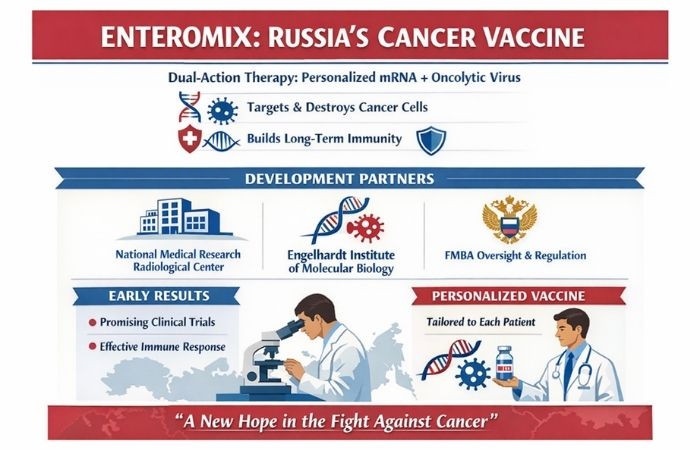
Russia’s cancer vaccine, known as Enteromix, is a groundbreaking development in oncology. It’s a dual-action therapeutic vaccine that combines personalized mRNA technology with an oncolytic virus platform. This innovative approach is designed to trigger a highly specific immune response against cancerous cells.
The goal of the Enteromix vaccine is not just to treat cancer but to create long-term immunity against it. Early clinical trials have shown promising results, positioning it as a potentially powerful new tool in the fight against various forms of cancer.
Development History and Innovations
The development of Enteromix is the result of a powerful collaboration between some of Russia’s top biomedical institutions. The National Medical Research Radiological Center has been responsible for overseeing patient trials and clinical validation, ensuring the process meets rigorous standards. This work is supported by the Engelhardt Institute of Molecular Biology, which handles the genetic sequencing and design of the personalized vaccine components.
The entire process is regulated by the Federal Medical-Biological Agency (FMBA), which ensures safety, production quality, and ethical compliance. Years of research have gone into creating this platform, with leaders like Veronika Skvortsova of the FMBA highlighting its potential. The collaboration guarantees scientific precision and clinical integrity.
The innovation behind Enteromix stems from its personalized nature. Rather than a one-size-fits-all solution, each vaccine is tailored to the individual, representing a significant step forward from traditional treatments. The Russian Ministry of Health continues to monitor the progress of these clinical trials.
What Makes Enteromix Unique Among Cancer Vaccines
Unlike many other mRNA cancer vaccines in development, Enteromix stands out due to its dual-action mechanism. It doesn’t just rely on mRNA to teach the immune system; it also uses an oncolytic virus to amplify that response. This combination makes it a highly potent form of precision oncology.
The vaccine’s uniqueness is rooted in its deep personalization. By analyzing the specific mutations of a patient’s tumor, scientists can create a personalized cancer vaccine that is incredibly precise. This targeted approach helps avoid the collateral damage often associated with traditional cancer therapies.
Here’s what sets it apart:
- Dual-Action Therapy: Combines mRNA instructions with viral oncolysis for a stronger attack.
- Deep Personalization: Each vaccine is created based on the patient’s unique tumor genetics.
- Use of Artificial Intelligence: AI is being integrated to improve the prediction of cancer-specific neoantigens.
Mechanism of Action: How Enteromix Works
Enteromix operates by turning your own immune system into a powerful weapon against cancer. It’s a form of cancer immunotherapy that uses two distinct but complementary strategies. First, it uses mRNA technology to train your immune cells to recognize and hunt down cancer cells based on their unique genetic markers.
Second, it employs an oncolytic virus to directly attack and break apart tumors. This process releases more cancer markers into your system, further stimulating and strengthening the immune attack. This dual mechanism ensures a comprehensive and sustained assault on the cancer.
Dual-Action Immunotherapy Explained
The core of Enteromix’s power lies in its dual-action immunotherapy. This approach creates a self-reinforcing cycle that targets malignant cells with remarkable precision. It begins by educating the immune system and then amplifies the attack for a more robust outcome.
First, the personalized mRNA component instructs T-cells—your body’s immune soldiers—to identify unique markers on tumor cells. This ensures that the immune response is directed only at the cancer, leaving healthy tissue unharmed. It transforms your immune system into a living therapy that can adapt and provide ongoing surveillance against recurrence.
Then, the oncolytic virus component kicks in, providing a biological boost.
- Targeted Infection: The viruses are engineered to infect and replicate only inside cancer cells.
- Tumor Lysis: This replication causes cancer cells to burst, releasing more antigens and supercharging the immune response.
- Systemic Immunity: The process helps the body detect and destroy cancer cells that may have spread elsewhere.
The Role of mRNA Technology and Oncolytic Virus Platform
The mRNA technology in Enteromix works at the molecular level. Each vaccine is customized following a detailed genetic analysis of each patient’s tumor. Scientists identify unique mutations, called neoantigens, and encode them into an mRNA molecule. When administered, this mRNA gives your immune system a “most wanted” list for cancer cells.
Simultaneously, the oncolytic virus platform acts as an amplifier. Enteromix uses a blend of four non-pathogenic viruses that are specifically engineered to target and infect only cancer cells. This is particularly effective for certain cancers, including specific types of melanoma, where triggering a strong immune reaction is crucial.
Once inside a tumor, these viruses replicate until the cancer cell bursts. This process, known as oncolysis, not only kills the cell directly but also flags the tumor for a more aggressive attack by the newly trained immune system. This synergy between mRNA and the oncolytic virus is what makes the therapy so promising.
Clinical Evidence: Success Rates and Real-World Data
The initial clinical trials for Enteromix have provided exciting data on its efficacy and safety. In a study involving patients with colorectal cancer, the results were highly encouraging. A significant percentage of participants experienced a noticeable tumor size reduction, with some achieving long-term remission.
What’s equally important is the vaccine’s safety profile. Patients in the trial reported minimal side effects, especially when compared to the harsh effects of chemotherapy. This real-world data suggests that Enteromix could offer a powerful therapeutic benefit without compromising a patient’s quality of life.
Reviewing Clinical Trial Outcomes and Claims
Claims of 100% success often circulate, but it’s important to understand the context of the clinical trials. The initial Phase I human trials for Enteromix on 48 colorectal cancer patients did yield remarkable results. While not a cure-all, the outcomes demonstrated significant efficacy.
The reported 100% figure refers to the percentage of participants who showed a measurable anti-tumor immune response after vaccination, not a 100% cure rate. This is still a major achievement, as it proves the vaccine successfully activates the immune system against cancer. The journey from preclinical trials to widespread use is long, but these initial findings are a strong foundation.
Here is a summary of the Phase I trial outcomes:
| Metric | Result |
|---|---|
| Anti-Tumor Immune Response | 100% of participants showed a measurable response. |
| Tumor Size Reduction | 60-80% of participants experienced tumor shrinkage. |
| Serious Side Effects (Grade 3+) | 0% of participants reported severe adverse effects. |
These results suggest the potential for long-term remission and a high degree of safety.
Expert Opinions and Safety Considerations
While the initial trial data is promising, expert opinions emphasize the need for more extensive research before drawing final conclusions. The main point of praise is the vaccine’s excellent safety profile. In the first human trial, there were no reports of severe side effects (Grade 3 or higher), which is a significant advantage over many traditional cancer treatments.
However, experts caution that larger, more diverse clinical trials are necessary to fully understand long-term safety and effectiveness across different populations. Before the vaccine can receive official approval for widespread use, it must undergo further validation to confirm these early findings.
Key safety considerations include:
- Mild Side Effects: Patients typically experience only minor immune activation symptoms like fatigue or localized inflammation.
- Long-Term Monitoring: Continued monitoring is needed to ensure no unexpect long-term side effects emerge.
- Regulatory Scrutiny: The vaccine will face rigorous review from health authorities before becoming widely available.
Conclusion
In summary, understanding the intricacies of Russia’s cancer vaccine, Enteromix, is crucial as it represents a significant advancement in cancer treatment. From its unique dual-action mechanism to promising clinical evidence, this innovative approach has captured the attention of both experts and patients alike. As more research emerges, it becomes increasingly clear that Enteromix could offer new hope for those affected by cancer. Staying informed about such developments can empower patients and their families in making educated health choices. If you’re curious to learn more about how Enteromix could impact treatment options, feel free to reach out for more information or a consultation.
Frequently Asked Questions
Is Enteromix expected to launch in India soon?
There is currently no official timeline for the launch of Russia’s cancer vaccine in India. Any international availability will depend on the completion of further clinical trials, regulatory processes, and official approval from Indian health authorities. Cancer patients should rely on official sources for updates.
Which cancers can Enteromix treat?
Enteromix has shown success in early trials for colorectal cancer. Research is expanding to other solid tumors like glioblastoma, melanoma (a type of skin cancer), lung, breast, and pancreatic cancer. Its adaptable platform makes it potentially suitable for any solid tumor with identifiable mutations, but it is not currently indicated for blood cancer.
How does Russia’s cancer vaccine compare with global options?
Russia’s cancer vaccine is unique due to its dual-action mechanism combining an oncolytic virus with mRNA cancer vaccines. While other international cancer treatments also use mRNA or immunotherapy, Enteromix’s combined approach may offer enhanced efficacy. It stands as a promising alternative to traditional chemotherapy by personalizing treatment.
Disclaimer
The information provided in this guide is for general informational and educational purposes only and does not constitute medical advice. It is not intended to be a substitute for professional medical diagnosis, treatment, or advice